

Commentary
Rym Momtaz, ed.
{
  "authors": [
    "Rym Momtaz"
  ],
  "type": "commentary",
  "blog": "Strategic Europe",
  "centerAffiliationAll": "",
  "centers": [
    "Carnegie Endowment for International Peace",
    "Carnegie Europe"
  ],
  "englishNewsletterAll": "",
  "nonEnglishNewsletterAll": "",
  "primaryCenter": "Carnegie Europe",
  "programAffiliation": "",
  "regions": [
    "Europe",
    "Ukraine",
    "United States",
    "Russia"
  ],
  "topics": [
    "EU",
    "Foreign Policy",
    "Military",
    "NATO"
  ]
}
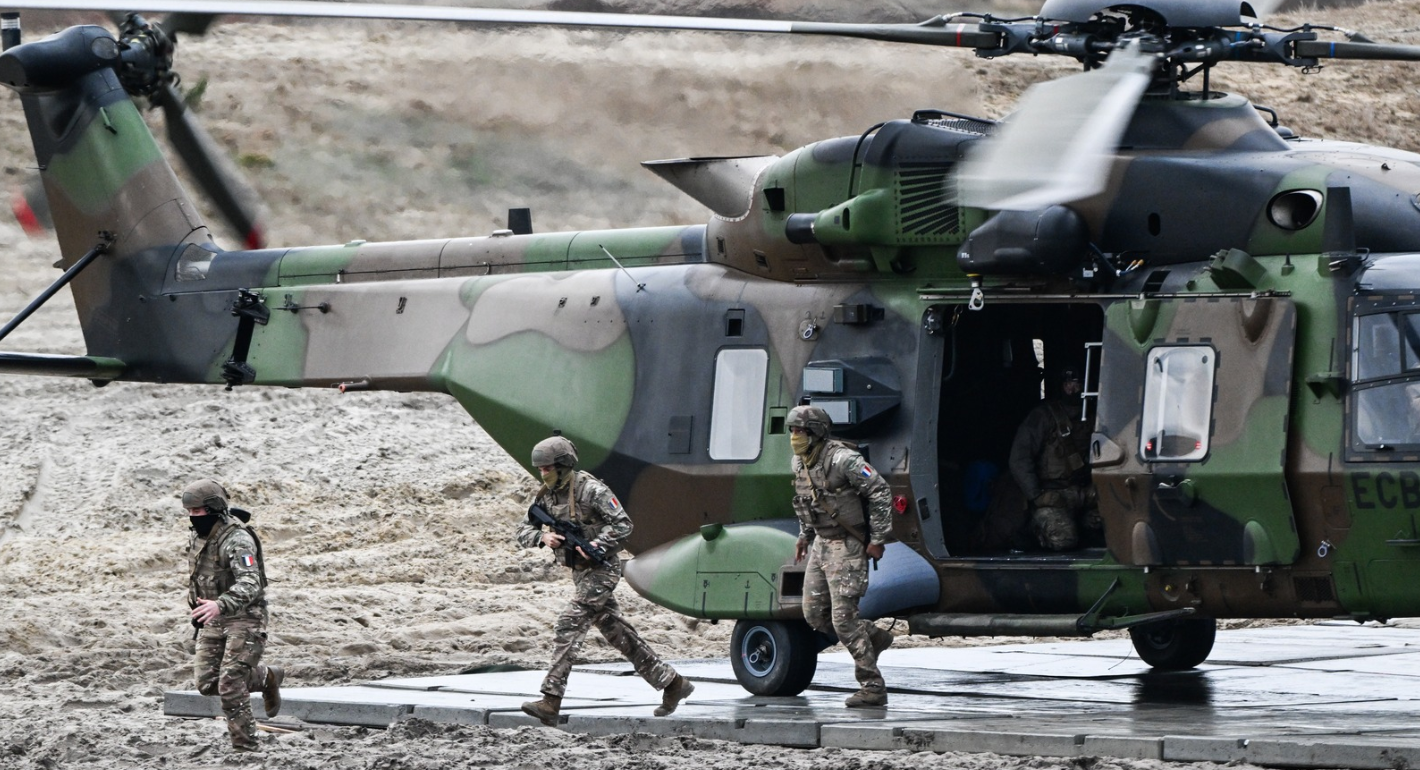
Source: Getty
A trilateral summit in China was advertised as the new Yalta but yielded little more than a photo opportunity for Vladimir Putin. The real work was being done by the Europeans, quietly, in rural Poland.
All eyes were on Shenzhen in China, but the seeds of a new European security architecture may have been sown more than 8,000 kilometers away in Nowa Dęba in Poland.
Eleven countries from the much-derided and often disappointing Coalition of the Willing held their first training exercise 100 kilometers away from the Ukrainian border.
In a way, it may seem ridiculous to compare that with a meeting of the leaders of China, Russia, and the United States. But while the trilateral meeting at the APEC summit in Shenzhen was certainly loaded with symbolism, the Europeans were—unusually—doing concrete work for their security.
The parallel between the two events should serve as a reminder to Europeans obsessed with always being at America’s table: that they have the ability to convene their own table and that if they back it with enough political will and concrete capacity, it could even come to be a better alternative.
Admittedly, that’s a big if, and the theory still needs to be proved in practice. The Coalition of the Willing is not a game changer—at least not yet. It has been slow and has struggled to set the right level of military ambition. But even by these low expectations, the timing and location chosen for its first military exercise are noteworthy. The event may even prove, years down the line, to have been foundational for the continent’s security.
It is the first operational translation of an entirely European military chain of command, conceived to deter renewed Russian aggression. Whether this is the embryo of a NATO 3.0 or a Europeanized NATO remains to be seen. What is sure, though, is that the Europeans are learning to coordinate operations without the American nervous system they have always relied on.
That is no small feat given their divergent views on how to step up in light of Washington’s changing posture. The timing is even more noteworthy, coming on the heels of two U.S. moves that, whether deliberately or not, played into longstanding Russian designs on Europe.
First, in Abu Dhabi, the United States treated as legitimate Russia’s desire to discuss a new security architecture in Europe before a ceasefire and resolution to the war in Ukraine could be reached. In doing so, it signaled that invasions could be rewarded instead of deterred and defeated.
Second, and only a few days later in Shenzhen, U.S. President Donald Trump granted Russian President Vladimir Putin’s dream of portraying Moscow as one of the three masters of the universe—to the exclusion of Europe.
Trump broke with decades of U.S. presidents who refused to hold such a trilateral summit, precisely not to be seen to put America’s two main adversaries on equal footing with the United States. Previous presidents also sought to hammer home the idea that, apart from its nuclear arsenal, modern-day Russia is a second-rate power.
Instead, Trump went as far as posting a meme on social media declaring Putin his friend, just as Russian missiles continued to rain on Ukrainian civilian targets. And by ceding control over the optics, protocol, and logistics of the summit to Chinese President Xi Jinping, he actively reduced the United States to the same rank as Russia, giving China prime billing. The vacuity of the summit’s substance only highlighted that symbolic defeat.
In contrast, back in Brussels, Berlin, and Nowa Dęba, Europeans signaled that they were growing more confident in diverging from Trump’s America in their assessments of how to secure their continent from the growing threat of Russia. They did so while recognizing that the United States and its critical enablers remain vital and that NATO, with Washington’s backing and participation, is the backbone of European security.
But despite the United States having unilaterally withheld early warning and other critical support to force Ukraine’s hand in negotiations with Russia, Kyiv and its European backers have pressed on. This has been especially true with regard to strikes deep within Russian territory on both military and dual-use targets.
The issue came to a head again with a blunt rebuttal coming from the most unexpected source. After U.S. Under Secretary of Defense for Policy Elbridge Colby said Ukraine’s deep strikes “have not been effective in driving an end to the war” and “have actually probably hardened the Russian public’s resolve and the Kremlin’s own willingness to escalate,” German Defense Minister Boris Pistorius responded, calling the remarks “quite a stupid thing.”
Taken as a whole, the sequence should remind Europe of the agency it can have and the confidence it should have.
This admittedly optimistic read faces an uphill battle. With Europeans now funding the entirety of Ukraine’s military, economic, and humanitarian needs, the current fight over the EU’s long-term budget underscores the challenge ahead. With upcoming elections in France, Italy, Poland, and Slovakia, where the momentum favors populist parties, these budgetary convulsions will only grow.
In nearly all possible outcomes, the French presidential election of spring 2027 will cast a particularly long shadow given Paris’s weight. The two candidates who have consistently led polling, the far-right leader Marine Le Pen and far-left candidate Jean-Luc Mélenchon, have been explicit that they would end the country’s aid to Ukraine. Neither would take a leadership role in building European strategic autonomy or sovereignty.
While France’s per-GDP contribution to military aid to Ukraine has been subpar, the Coalition of the Willing and its operational translation would not exist without Paris. Its driving force and operational military role will be hard to replace: Germany lacks the military expertise, the UK lacks the spare capabilities, and Poland is too politically fraught to lead.
Yet, someone will have to step up and build on what has already been established. The past four years have proven that the Europeans can do it, even if it comes in maddeningly slow fits and starts. Their only option is to simultaneously build up their independent capabilities, while managing their U.S. dependence by working through incremental inflections of Washington’s policy that, when added up, could make the difference between submission and sovereignty.
Subscribe to Strategic Europe, delivered every Tuesday and Thursday!

Editor in Chief, Strategic Europe
Rym Momtaz is the editor in chief of Carnegie Europe’s blog Strategic Europe. A multiple Emmy award-winning journalist-turned-analyst, she specializes in Europe and the Middle East and the interplay between those two spaces.
Recent Work
Rym Momtaz, ed.
Rym Momtaz
Carnegie does not take institutional positions on public policy issues; the views represented herein are those of the author(s) and do not necessarily reflect the views of Carnegie, its staff, or its trustees.
Russia’s maximalist demands are preventing any serious attempt at ending the war in Ukraine. To make peace a realistic prospect, Putin must recognize that diplomacy is a two-way street.
Kadri Liik

Too many national interests, too many EU institutions, and too little political will are preventing Europe from acting in its own best interests.

Judy Dempsey
A sizeable funding shortfall looks increasingly likely to hit Ukraine in 2027. Can the Europeans, with their strained budgets and economies, come up with the cash without seizing frozen Russian assets?
Rym Momtaz, ed.
A blue wave has swept over the U.S. midterms, with Democrats regaining control of both houses of Congress. But Europeans hoping for a return to business as usual should think again.
Rym Momtaz
In Germany, competing perceptions of Russia are highlighting a tension between public opinion and government policy. In the country’s east, where division is widespread, populist parties are taking advantage.

Gwendolyn Sasse